WORLD NEWS | POLITICS | GLOBAL ECONOMY
Putin Criticizes EU Sanctions as Trump and Xi Prepare for APEC Talks
Russian President Vladimir Putin attacks Western sanctions
while Chinese President Xi Jinping calls for stronger
trade and technology cooperation ahead of a major
meeting with Donald Trump in Shenzhen.
SHENZHEN, China, November 18, 2026 –
Russian President Vladimir Putin has criticized
European sanctions against Moscow, describing them
as harmful to businesses and ordinary citizens.
His remarks came ahead of a high-profile meeting
with U.S. President Donald Trump and Chinese
President Xi Jinping at the Asia-Pacific Economic
Cooperation (APEC) summit in Shenzhen, China.
The three leaders gathered in China as global
tensions over trade, energy, technology, and
international security continued to shape
relations between major economic powers.
While Putin focused on the economic consequences
of Western sanctions, Xi used his remarks to
promote a more open regional economy and greater
international cooperation in technology.
Putin Says European Sanctions Are Hurting Businesses
Speaking at a welcome banquet ahead of the main
APEC discussions, Putin argued that restrictions
on trade and energy supplies had created
significant economic challenges for Europe.
He specifically criticized European measures
against Russian energy exports, arguing that
the restrictions had disrupted access to
affordable and stable energy supplies.
Putin claimed that European businesses and
consumers were facing increasing pressure
because of higher costs and declining living
standards.
He also described the economic situation
in the Eurozone as being in a state of
serious decline.
His comments reflect Moscow’s continued
opposition to Western economic restrictions
introduced following Russia’s full-scale
invasion of Ukraine in February 2022.
European Union Prepares Additional Sanctions on Russia
Putin’s criticism came as the European Union
prepared another package of sanctions targeting
Russia’s economy.
The proposed measures were expected to cover
several sectors, including Russian oil refineries,
financial institutions, e-commerce activities,
and companies suspected of supporting Russia’s
so-called shadow fleet.
The shadow fleet refers to networks of vessels
used to transport Russian oil and other energy
products, often through arrangements designed
to avoid international restrictions.
The European Union has continued to use
economic sanctions as part of its broader
strategy to pressure Moscow over the war
in Ukraine.
However, Russia maintains that such restrictions
have failed to weaken its economy as Western
governments intended.
Xi Jinping Calls for Open Trade and Stronger
International Cooperation
Chinese President Xi Jinping used his APEC
address to call for fewer trade and investment
barriers across the Asia-Pacific region.
Xi emphasized the importance of building
an open regional economy and maintaining
stronger cooperation between trading partners.
His remarks came at a time when international
trade relations have faced growing pressure
from tariffs, export restrictions, and
geopolitical disagreements.
China has sought to present itself as a
supporter of international trade cooperation,
particularly as tensions with the United States
continue over tariffs and access to advanced
technologies.
Xi also called for deeper cooperation in
artificial intelligence, digital technology,
scientific research, and innovation.
Artificial Intelligence Becomes a Key Issue
in US-China Relations
Artificial intelligence was another important
topic during the summit.
Xi encouraged countries to strengthen
partnerships in science and technology,
particularly in the digital economy
and artificial intelligence.
His comments come amid growing competition
between Washington and Beijing over advanced
semiconductor technology and AI infrastructure.
The United States has introduced restrictions
on China’s access to certain advanced
artificial intelligence chips, including
products from major semiconductor companies
such as Nvidia.
These restrictions have become a major
source of tension between the two countries,
particularly as AI technology becomes
increasingly important to economic growth,
national security, and global competitiveness.
Trump Arrives in Shenzhen for High-Level Talks
U.S. President Donald Trump arrived in
Shenzhen on November 18, where he was
welcomed by Xi Jinping.
The arrival ceremony attracted attention
because Xi personally greeted Trump at
the airport, reflecting the importance
Beijing placed on the visit.
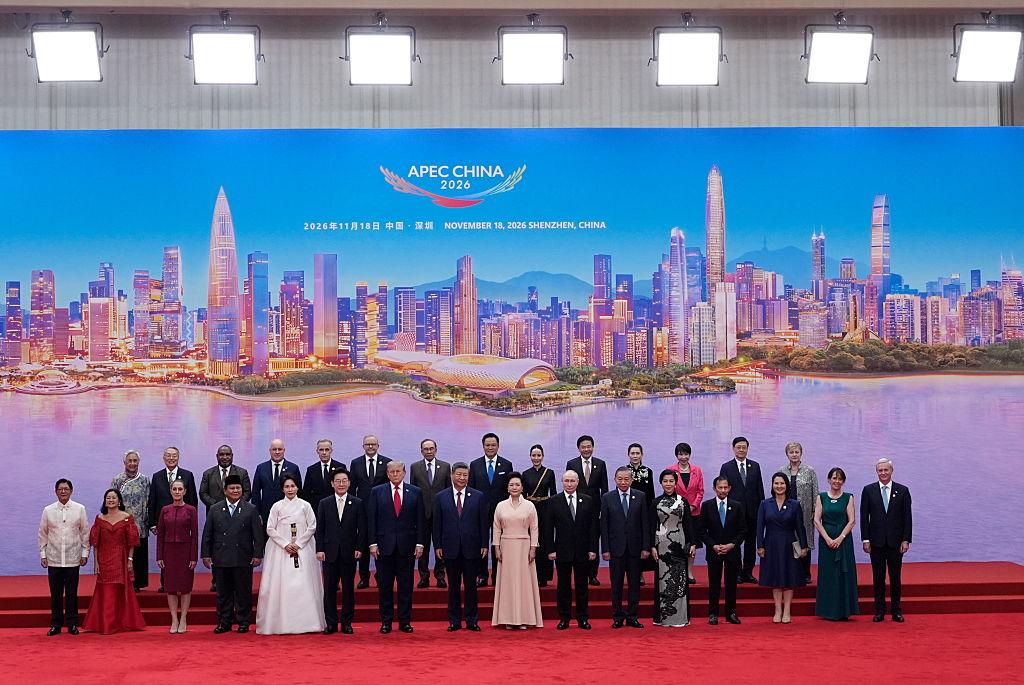
Trump and Xi later joined Putin at a
welcome banquet ahead of the scheduled
high-level discussions.
The meeting between the three leaders
was expected to cover several major
international issues, including the war
in Ukraine, trade relations, energy security,
artificial intelligence, and nuclear weapons.
The gathering is particularly significant
because it brings together leaders of
three of the world’s most influential
military and economic powers.
Ukraine War Remains a Major Challenge
for International Diplomacy
Russia’s ongoing war in Ukraine remains
one of the most difficult issues facing
international relations.
Although the planned discussions provide
an opportunity for diplomatic engagement,
significant differences remain between
Russia, the United States, and their
international partners.
The Kremlin indicated that the planned
discussions would be relatively limited
in duration, suggesting that expectations
for detailed negotiations should remain
measured.
European governments and other international
partners also remain concerned about the
possibility that major powers could make
decisions affecting regional security
without sufficient involvement from
smaller countries.
What the Trump-Putin-Xi Meeting Could Mean
for the Global Economy
The meeting between Trump, Putin, and Xi
comes at a critical time for the global
economy.
Trade disputes, energy market uncertainty,
technology restrictions, and geopolitical
tensions have created challenges for
governments and international businesses.
Any improvement in communication between
the three countries could influence
international trade, investment decisions,
and global security discussions.
However, major disagreements remain,
particularly over Ukraine, economic
sanctions, technology access, and
international trade policies.
For now, the APEC summit represents
an important diplomatic opportunity.
Whether the discussions will lead to
meaningful agreements remains uncertain.
APEC Summit Highlights Growing Global
Economic and Political Divisions
The contrasting messages from Putin
and Xi highlight the different priorities
shaping international politics and trade.
Russia continues to challenge Western
sanctions, while China is promoting
stronger regional trade and technology
cooperation.
Meanwhile, Trump’s participation adds
another important dimension to the
diplomatic discussions, particularly
regarding relations between Washington,
Moscow, and Beijing.
As the three countries navigate their
competing interests, the outcome of
their discussions could have important
implications for international relations
and the global economic outlook.